
The Secret of Better Communication at Work
Dec 01, 2025
If you’ve ever walked away from a workplace conversation thinking, “Well… that solved nothing,” you’re not alone.
So many leaders and teams want communication that feels energizing, collaborative, and purposeful—but instead find themselves stuck in patterns that derail progress, flatten morale, and leave people feeling unheard.
Here's one of the best-kept secrets to improving communication skills at work: the type of questions we can can lead to more meaningful and productive conversations at work.
Are Meaningful and Productive Conversations at Work Really That Important?
Absolutely. Every day, conversations determine how well we connect with each other, solve problems, and keep work moving in the right direction.
When conversations are thoughtful and energizing, we build trust, clarity, and momentum almost without trying. When they’re rushed, reactive, or negative, they can slow everything down and leave people feeling discouraged or unheard.
If you're noticing conversations that leave people drained—or stuck in what’s wrong instead of what’s possible—there’s a huge opportunity to shift the tone and direction of your conversations.
It starts with the questions we ask. One of the most powerful tools for better communication at work is asking generative questions—one of the two simple practices of Conversations Worth Having.
Generative Questions vs Open-Ended Questions
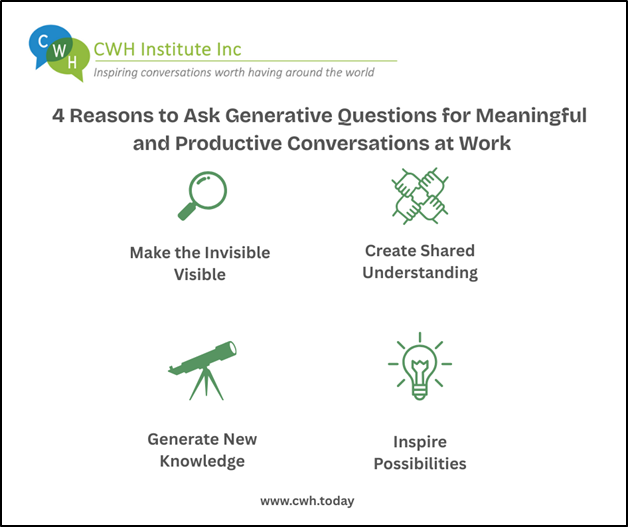
Although generative questions are open-ended, not all open-ended questions are generative. An open-ended question gives space for longer answers beyond a simple yes or no. A generative question is a specific category of open-ended questions that are designed to make the invisible visible, created shared understanding, generate new knowledge, and inspire possibilities.
Generative questions help you move beyond simply gathering information and they are typically questions for which you do not already have the answer. (Reflect on that for a moment, especially if you believe that a leader must have all the answers.)
When done well, a generative question intentionally surfaces and creates:
-
new understanding
-
shared meaning
-
curiosity
-
possibility
-
insight
-
connection
-
alignment
-
forward movement
They don’t simply invite more information—they invite insight which leads to better thinking, planning, and doing.
Generative questions help people see more, imagine more, and build more together.
When Should You Use a Generative Question?
Anytime you want to positively and proactively unlock potential in:
-
productivity & performance
-
alignment & engagement
-
workplace culture
-
conflict & tension
-
innovation & problem-solving
-
planning & strategy
-
employee growth & development
-
leadership conversations
How AI Helps (and Where It Falls Short)
Using Artificial Intelligence can be an incredibly helpful when you want to prepare for conversations, brainstorm ideas more quickly, and even clarify what you want to say before you say it. Sometimes, it’s like having a sounding board on demand.
But here’s the thing: AI can’t replace the human parts of a conversation.
It can’t sense tone or understand team dynamics and culture. It can’t feel the emotional undercurrents in a room or ready body language. It can’t build trust for you. And it definitely can’t create the kind of safe, authentic connection people need in order to collaborate well.
So yes—AI can support your conversations; it cannot stand in for your conversation. That’s still yours to create and participate in fully.
Why Practice Matters
Asking generative questions is a skill you can learn, internalize, and apply quickly.
And like any skill, the secret to making it a real strength so it becomes easier—and more natural—it to practice.
At first, it might feel unfamiliar to ask questions that open up possibility instead of narrowing things down. That’s normal. For decades, most of us have been trained and rewarded for asking critical questions—questions designed to diagnose what’s wrong, find the flaw, or limit the range of answers. Responses to critical questions met leaders needs at the time; historically, they didn’t need much more than yes/no responses or surface-level information to keep work moving. That approach worked fine in more predictable environments.
Today, as the world continues to change, leaders need more from their conversations:
- They need insights—not just data.
- They need shared understanding—not just updates.
- They need knowledge that can be acted upon—not just information.
That’s where generative questions change everything. They unlock the thinking, meaning-making, and creativity required to navigate complexity and build what comes next.
Practicing asking generative questions helps you:
-
know when to apply it
-
feel confident using it in real conversations
-
experience how it shifts the tone and direction of conversations
-
grow your own awareness
-
influence conversations from the inside out
One of the best ways to start your practice of asking generative questions is to start with your internal dialogue, and a terrific resource for that is our Conversations Worth Having with Yourself, a QuickStart Guide for Building Resilience.
Final Thought
When we shift our conversations at work, we strengthen our ability to motivate, collaborate, and innovate. As those capabilities grow, we improve performance and outcomes in ways that distinguish us from others—and create lasting advantage.
Small conversational shifts can unlock big results one generative question at a time.
Learn more about generative questions and how to use them for meaningful and productive conversations at work in our 30-minute CWH Foundations Course. There's never been a better time to shift the tone and direction of conversations that will help you navigate change and create a future worth having.
Shared by: Kelly Stewart, co-founder in the CWH Institute Inc., certified Conversations Worth Having Trainer, and certified Appreciative Inquiry Facilitator. She's also the founder of The Positive Business, facilitating strategic conversations that bridge strategy and culture, believing deeply that better results begin with better conversations.
